Auto parts industry development status and trends
Auto parts industry development status and trends
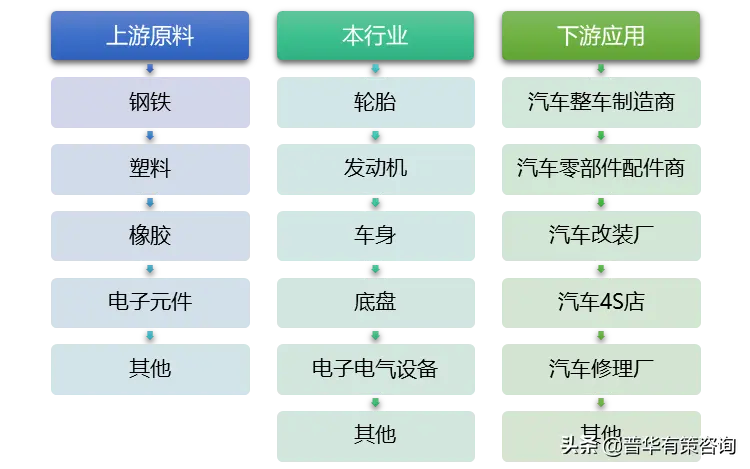
Auto parts refers to all parts and components other than car frames, where parts refer to individual components that cannot be disassembled, and components refer to the combination of parts that realize a certain action or function. Auto parts industry as the upstream of the automotive industry, is an important part of the automotive industry, and the automotive industry to promote each other, common development. In the context of economic globalization, market integration, in recent years, the continuous increase in motor vehicle ownership, auto repair and auto tuning and other after-market demand for parts and components also expanded, the performance of auto parts and components are increasingly demanding. Auto parts industry as the foundation of the auto industry, is an important factor to support the sustainable and healthy development of the auto industry.
Source: Puhua Youzhi
1, China's auto parts industry development profile
At present, the market concentration of China's auto parts manufacturing enterprises is relatively low, there are many small-scale enterprises in the low-end market, initially small and medium-sized enterprises can obtain certain profit margins by virtue of cost and price advantages, but with the intensification of market competition, profit margins are gradually compressed, many small suppliers face the risk of being eliminated from the market. However, the large scale manufacturers in the industry can continue to play the advantage of independent innovation, with high-end high-quality products in the market to gradually expand market share, accelerate the pace of mergers and acquisitions, integration of industrial chain, and continue to expand to overseas markets. Overall, China's auto parts industry has the trend of further increase in market concentration.
With the gradual structural optimization and product upgrading of China's parts industry, China's auto parts enterprises have grown from 12,090 in 2015 to 14,018 in 2020, with a total main business income of 3,631.65 billion yuan in 2020, and the average annual compound growth rate of industry revenue from 2010 to 2017 was 14.58%, with the overall industry in a state of high growth. In 2018, due to the overall industry downturn, the main business revenue of the auto parts industry decreased, however, with the recovery of China's economy and the expansion of domestic demand in the auto industry, the main business revenue of the industry increased in 2019 and 2020, up 5.98% and 1.55% respectively, reversing the previous downward trend.
In addition, under the influence of the trend of global allocation of the auto industry chain, China's auto parts components and accessories export market also shows a growth trend. 2017 to 2020, China's auto parts and accessories export value increased from RMB 210.112 billion to RMB 227.703 billion. 2020 auto parts and accessories industry is affected by the new crown epidemic, there is a slight decline from the previous year. However, the decline is not significant compared with that of the whole vehicle industry, mainly due to the insufficient supply capacity of overseas auto parts and accessories suppliers, the still strong overseas import demand for domestic auto parts and components, and the steadily rising domestic after-sales demand in the context of larger vehicle ownership.
As China's auto parts and components industry by years of competitive development and experience accumulation, enterprise production scale, product development capabilities and technological innovation capabilities have been greatly enhanced.
In recent years, due to the "national three out", "the new national six emission standards" and the treatment of non-compliant vehicles and other policies, driven by the stage of centralized procurement and replacement of vehicles, the release of market demand. Secondly, the "medium and long-term development plan for the automotive industry" and Zhejiang, Guangdong and other provinces launched a number of regional automotive industry development plan and other policies to promote the guidelines to further promote the upgrading of product technology and auto parts enterprises in line with the national strategic development plan of auto parts enterprises to increase investment in important products, and actively layout. In addition, after years of development, domestic enterprises continue to achieve breakthroughs in key technologies, some enterprises, whether in service or technology, have initially had the strength to compete with foreign manufacturers. With the continuous improvement of the layout of the auto industry, China's auto parts industry continues to enhance its competitiveness, and fully utilize its own advantages, seize the window of industry chain transfer and procurement globalization, and participate deeply in the international auto industry chain. China has gradually become an important area for the layout of parts giant enterprises, and the amount of auto parts exports has grown steadily.
With the increase of industrial concentration, China's auto parts manufacturing enterprises have gradually formed six industrial clusters, forming a cluster effect of the whole auto industry chain, such as auto vehicle manufacturing and parts manufacturing, which not only reduces transportation costs, but also helps to amplify the advantages of large scale, laying a good foundation for the auto industry to further expand the market scale. The six industrial clusters that collect the vehicle manufacturers and supporting industrial parks are located in the Yangtze River Delta region, the southwest region, the central region, the northeast region, the Bohai Sea region, the Pearl River Delta region, balanced distribution in all regions of the country, both close to the consumer market, but also has the geographical advantage of exporting overseas. This layout will help China's auto parts industry's sustainable and healthy development, and gradually transition to a centralized, professional and mature market stage.
2, the future development trend of the auto parts industry
With the automotive manufacturing industry into a mature stage of development, the vehicle manufacturers pay more and more attention to the scale of production of auto parts, professional division of labor, cost control. The future development trend of the auto parts industry has the following main directions:
(1) product integration, modularization: in order to improve the level of automation and accuracy of the vehicle installation process, improve production efficiency, optimize the vehicle space structure, improve vehicle performance, automotive parts from a single component to the direction of integration, modular unit development.
(2) high-end products, refinement: with the continuous improvement of China's industrial strength, the production mode of auto parts has gradually from the original low-end rough type to high-end fine type development, more and more domestic high-end products began to replace the original foreign imports of high-end products.
(3) product lightweight, energy-saving: the current large number of global car ownership has aggravated the consumption of oil resources and auto exhaust.
The huge number of cars in the world has aggravated the consumption of oil resources and the emission of exhaust gas, causing global energy security and environmental protection problems, and countries around the world have promulgated corresponding laws, regulations and policies to advocate the concept of energy saving and emission reduction and environmental protection. In this context, the realization of lightweight and energy-saving automobiles can reduce the consumption of petroleum resources, reduce emissions and reduce the cost for consumers. The development of new energy vehicles is also a global consensus. The EU's public environmental protection and emission reduction plan stipulates that the sale of fuel cars will be banned in EU countries by 2035, and carbon neutrality will be achieved by 2050. At the 75th session of the United Nations General Assembly, China proposed that it would strive to achieve peak carbon emissions by 2030 and carbon neutrality by 2060. Therefore, encouraging the development of new energy vehicles and low-energy, small-emission vehicles has become an effective way for the automobile industry to save energy and reduce emissions.
(4) Operation automation and intelligence: With the improvement of China's economic level and the increase of labor salary level, the labor cost of manufacturing enterprises has also increased, and the advantage of the original demographic dividend has weakened. Therefore, improving the level of automation and intelligence of enterprise operation and strengthening the control of production, procurement, sales and transportation can effectively reduce the operating cost and increase the profit of the enterprise.